
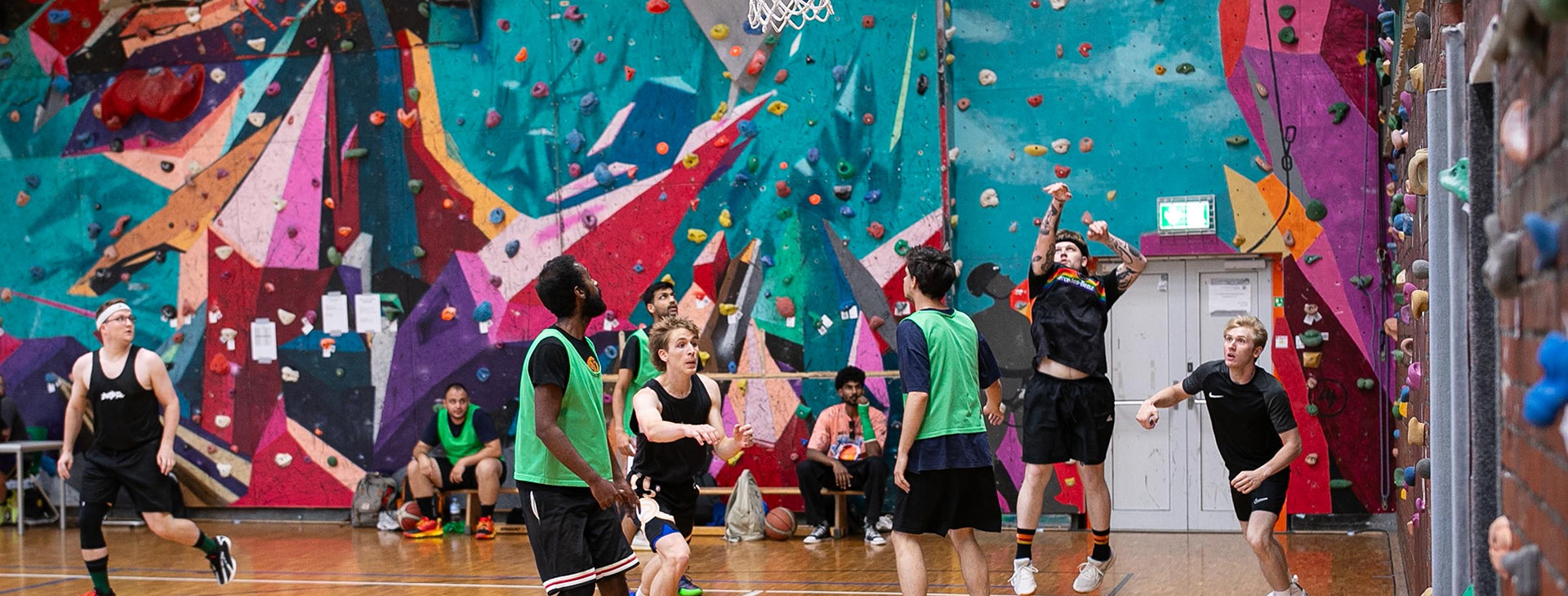
What do yoga, football, self-defence, diving, ballet, volleyball and a triathlon have in common? They’re all part of the university’s sports programme. And they demonstrate quite clearly that sport at university can be far more than just a way to unwind between lectures.
Every week, the University Sports Center brings exercise to the campus and, in doing so, brings people together. Around 14,000 students and some 2,500 staff members are part of the university sports programme’s target audience. The programme ranges from classic fitness and health-focused sports, through dance, water sports and martial arts, to more unusual activities and field trips. Around 300 sports courses across some 90 different disciplines are available each week.
Sport should be fun and bring people together
University sports is a voluntary programme. Nobody is expected to compete or achieve a specific level of performance. The focus is on exercise, fun and the opportunity to be active together with others.
“Especially whilst studying, it can do you a world of good to switch off for an hour, get some exercise and perhaps even meet new people in the process,” says Raja Dobbert, sports manager at the University Sports Center.
It is precisely this combination of sport and community that is a key part of university sport. When people train, dance, play or try out a new sport together, they naturally strike up conversations. A sports class can quickly lead to more: new contacts, friendships or simply the feeling of being part of a community.
From A for endurance to Z for one-on-one
Anyone who thinks university sport is just about football, volleyball or fitness will soon realise they’re wrong. The programme covers a wide range of sports. As well as fitness and health-focused activities, it includes games, martial arts, dance and water sports, amongst others.
There are suitable options for beginners as well as for advanced participants or students with sporting ambitions. Anyone wishing to try their hand at competitive sport can even represent the university at the German University Championships.
And sometimes things can be a bit more unusual: intensive courses and field trips offer experiences that go beyond the usual weekly classes. These include, for example, skiing field trips, surfing and kitesurfing courses, diving, tennis, self-defence or even gliding.
“We find it exciting when students discover sports through university sports that they might not have even considered before,” says Raja Dobbert. “Sometimes it’s not even about finding a new favourite sport for life. It’s simply about trying something out and taking away a new experience.”
One University Sports Center, many people behind it
Of course, ensuring that hundreds of sports activities can take place every week requires more than just a timetable. Behind the university sports programme is a team drawn from various departments.
The University Sports Center is headed by Dr Mario Damerow. Together with the sports managers Raja Dobbert, Ralf Müller, Katrin Holz and Julien Leitel, as well as Michéle Metzger and Tobias Römmling from the finance department, the team is responsible for the organisation, planning and further development of university sports.
In addition, there are numerous instructors every semester. Between around 90 and 110 people support the running of the courses. “Our instructors are a vital part of university sport,” says Dr Mario Damerow. “Many are students themselves and therefore understand the lives of our target group very well. They bring not only sporting expertise but also a special connection to the people for whom we organise our programmes.”
“University sport only works as a team effort,” adds Michéle Metzger from the Finance department. “Behind every course, which participants take for granted, there are many organisational processes. Our aim is for these to run smoothly in the background so that the sport itself can take centre stage.”
The Student Health Management (SGM) is
also based at the University Sports Center. This means that physical activity and health promotion are closely linked organisationally and can complement each other effectively in terms of content. Whilst university sport primarily creates a wide range of opportunities to be active and play sport together, the SGM takes a more holistic view of health within everyday student life.
CampusFIT: a training facility and meeting place in one
Another key component of university sport is CampusFIT, the university’s in-house gym. There, students and staff can train and improve their fitness using a range of strength and cardio equipment. “It’s lovely to see how different the people who come together here are, and how varied their goals are,” says Ralf Müller.
Students, staff and other members of all ages train side by side or even together to achieve their personal goals. It is precisely this mix that brings the place to life.”
Sport as part of campus life
As well as running regular classes, the University Sports Center also organises numerous events and competitions. These include, amongst others, the High-Rise Run, the Academic Bicycle Challenge, the Company Relay and the University Triathlon.
Such events bring physical activity out of the sports halls and classrooms and straight onto the campus.
In doing so, the University Sports Center collaborates with numerous partners both within and outside the university – including clubs, associations, health insurance providers, local authorities and other organisations.
For Dr Mario Damerow, it is precisely this networking that is a key part of the work: “University sport is part of university life. We don’t just want to organise sport; we want to help people feel at home at the university, connect with one another and experience the campus as a vibrant place.”
An offering for the whole person
Ultimately, therefore, university sport is about more than just building muscle, improving endurance or coordination skills, nor is it simply about setting a new personal best. Sport can also provide a balance to academic life, reduce stress, give people a new lease of life and bring people together. University sports creates the opportunities for this and makes sport a part of student and working life that moves people, brings them together and sometimes even enables them to surpass their own limits.
+Benjamin+Güllmar-height-730-width-1920.jpg)
+privat-height-730-width-1920.jpg)
+Jana+Dünnhaupt-height-730-width-1920-p-4587.jpg)
+Raja+Dobbert-height-730-width-1920.jpg)
+Jana+Dünnhaupt+Uni+Magdeburg-height-730-width-1920.jpg)