

An interdisciplinary team at the University of Magdeburg has developed a serious game designed to help international students settle into life in Magdeburg. Serious games combine playful elements with a specific learning objective. In this case, students get to know the city, key points of contact and everyday life in Germany. Along with accompanying comics on cultural differences, the project is among the top three entries in the DAAD and BMFTR’s ‘Campus Prize for International Skilled Workers’. A public online vote will now decide the final ranking.
A foreign city, a foreign language, unfamiliar dealings with the authorities: anyone who goes abroad to study has to find their feet not only academically but also in everyday life. At Otto von Guericke University Magdeburg, this problem has been tackled in an unusual way.
‘Alex’s New Start"’ is the name of the serious game, developed as a joint project between Gamelab Saxony-Anhalt at the Faculty of Mechanical Engineering, the Faculty of Computer Science and the Department of Media, Communication and Marketing at the University of Magdeburg. Using a map of Magdeburg, players complete tasks that reflect exactly what newcomers are concerned with during their first few weeks: Where can I find the citizens’ advice bureau? What do I need to bear in mind when looking for accommodation in Germany? Which type of rubbish goes in which bin? In the process, they pick up important German vocabulary along the way.

97 per cent of international students learnt something after playing "Alex' Neuanfang". (Photo: Jana Dünnhaupt/University of Magdeburg)
The first prototype was developed by international students from the Faculty of Mechanical Engineering, who drew on their own experiences of arriving in Germany. “They have developed a prototype of a serious game that closely reflects the real challenges of starting a degree in a new country",” explains Dr Maria Freese from the Gamelab. Since then, the serious game has been significantly further developed, resulting in a game that can now actually be used. The idea for the game stems from comics created at the Faculty of Computer Science, which use the character Alex to shed light on everyday university life. They address typical communication situations and misunderstandings in a university context that international students encounter in their daily lives, and are already being used at the Campus Welcome Centre, the first point of contact for students. “Alex’s New Start" expands on this approach to include the city of Magdeburg and practical everyday situations outside the university, with Alex continuing as the central character. “We deliberately chose the name Alex as it is gender-neutral and common in many countries",” says Dr Claudia Krull from the Faculty of Computer Science.
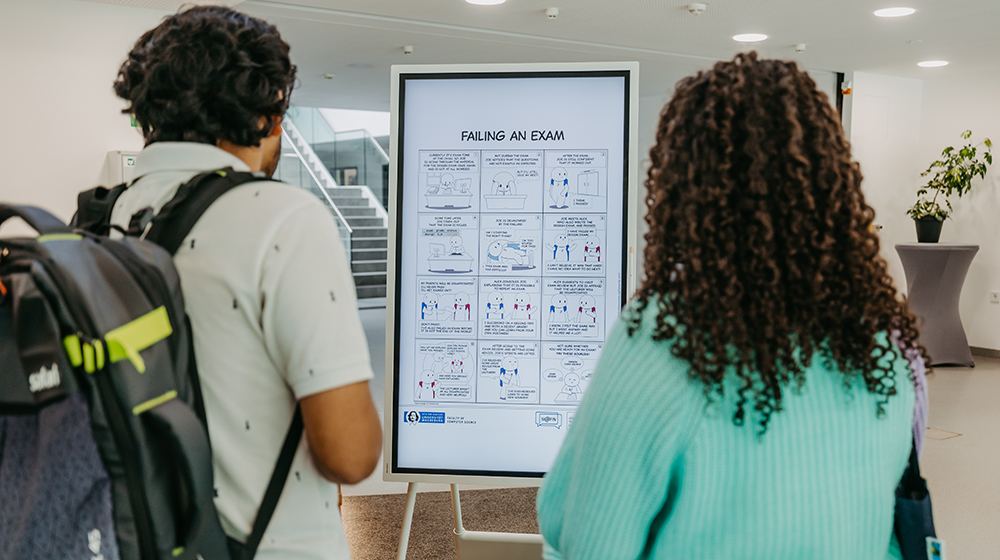
The serious game is based on comics featuring the character Alex. (Photo: Jana Dünnhaupt/University of Magdeburg)
Just how well the serious game works was demonstrated at a Game Night at the end of May, where international newcomers were able to get to know the game together. Among those present was Palakben Prajapati, a 22-year-old Master’s student from India, who has been studying Medical Systems Engineering since May. Before she left, she had been worried about the language barrier and about not being accepted in Saxony-Anhalt. These fears proved unfounded: “I’ve been given a warm welcome at the university and in the city,” she says. She is enthusiastic about the game itself: “It shows us what facilities there are in the city and where they are located, whilst at the same time introducing us to the German language in a playful way.”"
Data collected by the Gamelab team also clearly shows that the serious game supports the learning of the German language and an understanding of German culture. “97 per cent of international students have learnt something after playing ‘Alex’ Neuanfang’, be it new German vocabulary or information from specific scenarios, such as emergency numbers, waste separation, scams when looking for accommodation, and about Magdeburg itself",” explains Dr Maria Freese.
The serious game is now firmly integrated into welcome events for new international students. “The combination of finding accommodation, organisational steps, cultural misunderstandings and language makes "‘Alex’ Neuanfang" an exciting onboarding tool",” says Christin Gebauer from the International Office at the University of Magdeburg.

Using a map of Magdeburg, players complete tasks that reflect exactly what newcomers are concerned with during their first few weeks. (Photo: Jana Dünnhaupt/University of Magdeburg)
Part of a wider support programme
“Alex’s New Start" and the comics on cultural differences are just building blocks of the university’s wider commitment to its international students. This is made possible by the DAAD programme ‘FIT – Supporting International Talent for Integration into Higher Education and the Labour Market"’, through which the federal government is providing the University of Magdeburg with 1.2 million euros in funding. These include the ‘FIT for Career Start’ career certificate, which prepares students for their career start in Germany through language courses, job application workshops and contacts with companies; measures to ensure the academic success of international Master’s students in engineering – such as mentoring, workshops and interviews with lecturers – as well as the bilingual Bachelor’s programme (BiBa) in Computer Science. Here, students can begin their studies in either German or English and acquire specific skills in the other language during their course. All these initiatives are designed to attract international talent to Saxony-Anhalt as a place to work and live in the long term.
The university is also committed to promoting good academic and career prospects for its international students through other programmes, such as ‘MeCoSa MINT Career"’ at the Liaison Office for Gender Research & Equal Opportunities in Saxony-Anhalt (KGC) at the University of Magdeburg. This mentoring and coaching programme supports female students and graduates in STEM subjects with workshops, coaching, mentoring and networking opportunities as they embark on their careers in Saxony-Anhalt. It is funded by the European Social Fund Plus and the State of Saxony-Anhalt.
Vote now for the Campus Award!
With its onboarding initiative ‘Playful onboarding of international students through comics and the cooperative serious game “Alex: A New Beginning”"’, the University of Magdeburg has already made it into the final three for the Campus Prize for International Skilled Workers – selected from numerous entries – which is awarded by the German Academic Exchange Service (DAAD) and the Federal Ministry of Research, Technology and Space (BMFTR). The prize recognises projects at German universities that help international students settle into life in Germany and at their respective university campuses in a unique way. Public voting is now open.
“Alex’s New Start" is currently being further developed: the analogue serious game is intended to be used primarily during the induction weeks, alongside other onboarding formats, at the University of Magdeburg. At the same time, the team is already working on a digital version, which could be further developed with the support of the prize money and is intended to help international students prepare for their studies and everyday life in Germany whilst still in their home country, before they even arrive. The comics developed as part of the project can also be used at other universities with minimal effort, and the basic concept of the game set in Magdeburg is readily transferable.”
Anyone who would like to support the University of Magdeburg’s project, which helps international students settle in, is cordially invited to cast a vote to help ensure that “Alex’s New Beginning” wins the competition.